Cross-Border eCommerce Meaning: A Beginner's Guide to Global Online Selling
If you've recently come across the term cross-border eCommerce, you might be wondering what it actually means and why it's becoming such an important part of global online shopping. From buying products from overseas to selling in international markets, this business model connects buyers and sellers across different countries.
This guide explains the cross-border eCommerce meaning, how the process works, who can launch a global online business, the different business models, and the key benefits and challenges you should know before getting started.
What Does Cross-Border eCommerce Mean?
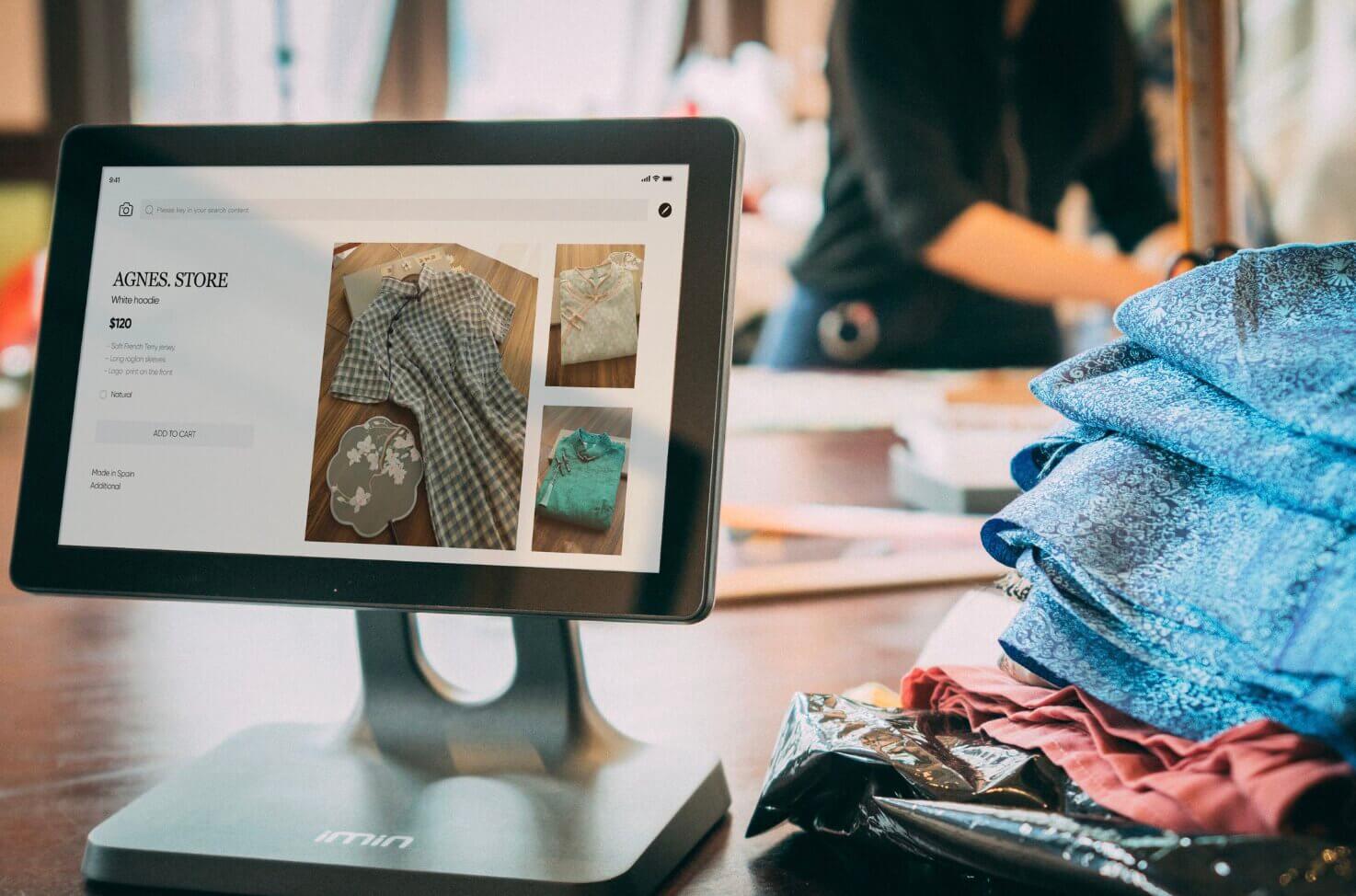
Cross-border eCommerce refers to the buying and selling of products or services between businesses and consumers located in different countries through online channels. Unlike domestic eCommerce, these transactions involve international shipping, cross-border payments, customs procedures, and localized shopping experiences.
According to market data from Juniper Research, global cross-border e-commerce transaction values are projected to grow by 107% over the next few years, climbing from $1.6 trillion to $3.3 trillion. This exponential rise is driven by shifts in consumer behavior and advanced supply chain infrastructure, with secondary market reports from McKinsey indicating that international shipments now account for roughly 15% to 20% of total physical goods e-commerce volume.
How Does Cross-Border eCommerce Work?
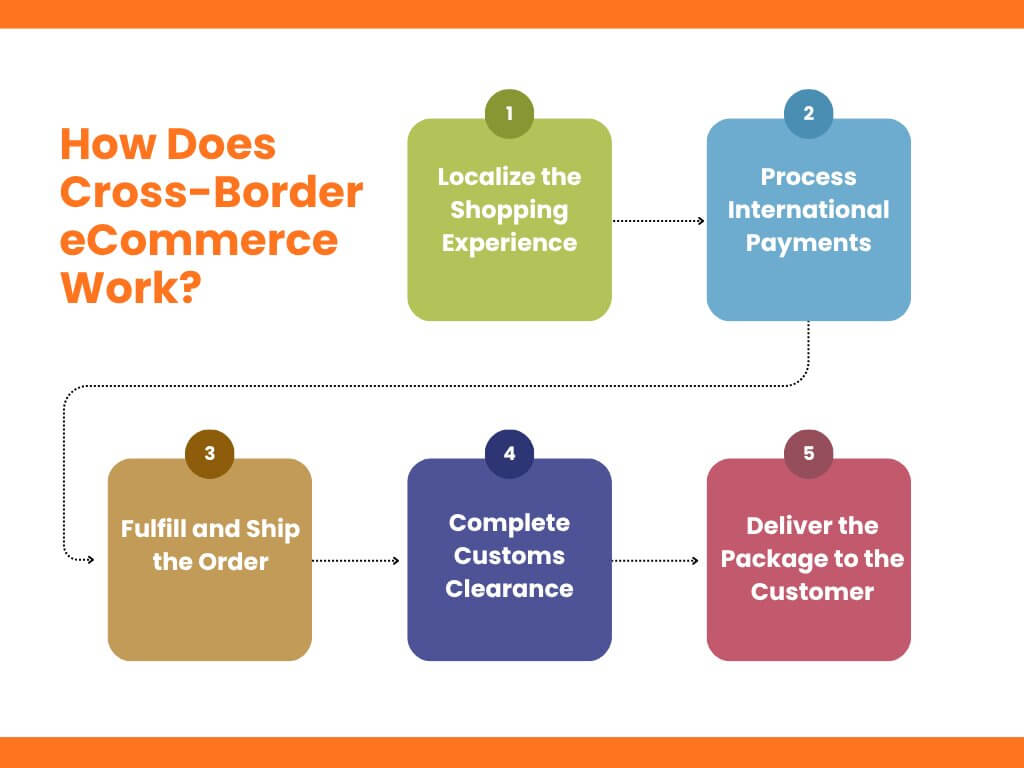
A cross-border eCommerce transaction involves more than simply shipping a product overseas. From the moment a customer visits an online store to the final delivery, several systems work together to create a smooth international shopping experience.
Step 1. Localize the Shopping Experience
The shopping experience is adapted for customers in different markets through localized language, currency, pricing, payment methods, and content. This helps international buyers browse and purchase products more comfortably while reducing friction during checkout.
Step 2. Process International Payments
Once an order is placed, the payment is securely processed through international payment gateways. Depending on the destination market, the system may also handle currency conversion, fraud screening, and payment verification before confirming the purchase.
Step 3. Fulfill and Ship the Order
After payment is approved, the seller prepares the order for shipment. This includes picking, packing, labeling, and handing the package to a domestic or international logistics provider. Some businesses also use fulfillment centers or warehouse consolidation services to streamline international shipping.
Step 4. Complete Customs Clearance
As the shipment enters the destination country, it must pass through customs. Authorities review the required documentation, assess applicable duties and taxes, and verify compliance with local import regulations before releasing the package.
Step 5. Deliver the Package to the Customer
Once customs clearance is complete, the shipment is transferred to a local delivery carrier for the final leg of the journey. Customers can typically track their orders until the package arrives at their doorstep.
Read more: Best Cross-Border E-Commerce Platforms for International Shopping
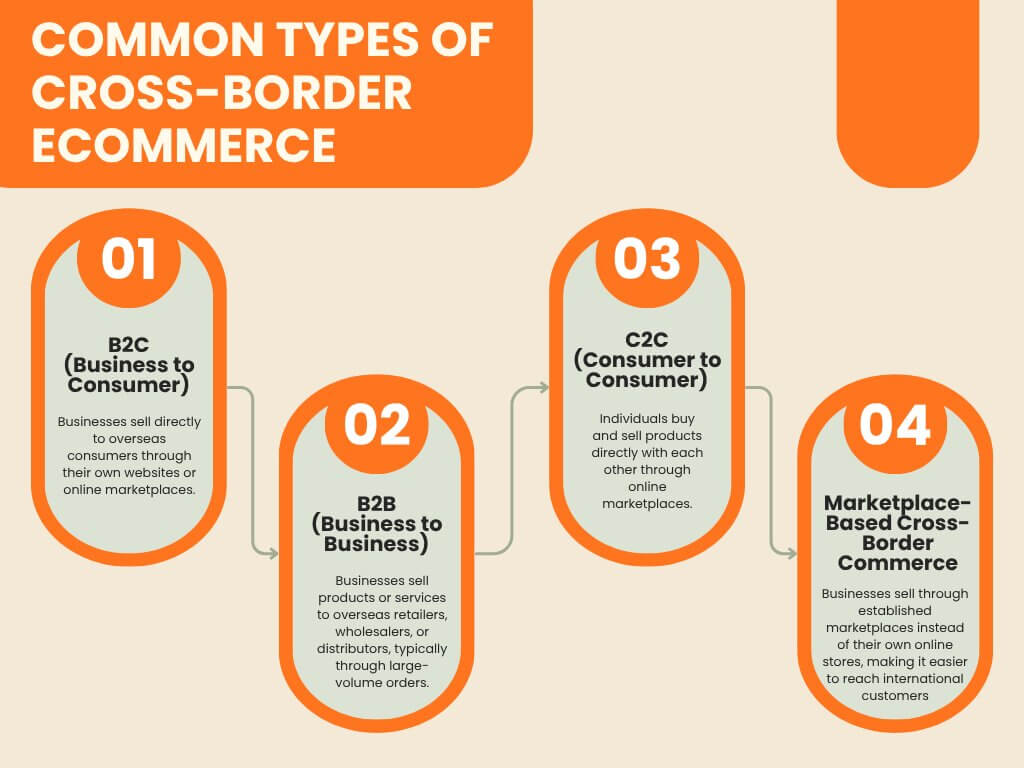
Common Types of Cross-Border eCommerce
Not all cross-border eCommerce transactions work the same way. The business model depends on who is buying, who is selling, and how products reach international customers. Understanding these models helps businesses choose the right sales strategy and gives consumers a clearer picture of how global online shopping works.
Business to Consumer (B2C)
Business to Consumer (B2C) is the most common cross-border eCommerce model. A business sells products directly to consumers in another country through its own website or an online marketplace.
This model is designed for individual purchases rather than bulk orders, so businesses typically focus on creating a smooth shopping experience. That includes displaying local currencies, offering familiar payment methods, providing accurate shipping estimates, and supporting international customer service.
Many direct-to-consumer (DTC) brands operate this way. For example, a Japanese skincare company shipping products directly to customers in the United States or a European fashion brand accepting orders from Southeast Asia are both B2C cross-border businesses.
Business to Business (B2B)
In a B2B model, products or services are sold from one business to another across international markets. Rather than serving individual shoppers, suppliers work with wholesalers, retailers, manufacturers, or distributors that purchase inventory for resale or business operations.
Compared with B2C, B2B transactions usually involve larger order quantities, negotiated pricing, longer sales cycles, and customized shipping arrangements. For example, a manufacturer in Japan exporting automotive components to retailers in Australia or a textile supplier selling fabrics to clothing brands overseas both operate through B2B cross-border eCommerce.
Consumer to Consumer (C2C)
Consumer to Consumer (C2C) enables individuals to sell directly to other individuals in different countries through online marketplaces. Instead of operating a registered business, sellers are often collectors, hobbyists, or people selling secondhand items they no longer need.
This model has become increasingly popular for products that are difficult to find through traditional retail channels. Vintage fashion, trading cards, anime collectibles, luxury handbags, and discontinued electronics are commonly traded between consumers worldwide. Platforms typically facilitate listings and payments, while shipping arrangements depend on each marketplace's policies.
Marketplace-Based Cross-Border Commerce
Marketplace-based cross-border commerce focuses on where products are sold rather than who is buying them. Instead of building and promoting their own eCommerce websites, businesses use established marketplaces that already attract large numbers of international shoppers.
Some platforms such as Amazon, Rakuten, eBay, Yahoo Shopping, and Mercari provide built-in traffic, payment infrastructure, and customer trust, allowing sellers to reach overseas markets more quickly. This approach is especially attractive for small businesses and first-time exporters because it reduces the cost of acquiring international customers.
However, marketplace selling also comes with trade-offs. Sellers have less control over branding, customer relationships, and platform policies, making it more difficult to build long-term customer loyalty than through an independent online store.
Real Examples of Cross-Border eCommerce
The easiest way to understand cross-border eCommerce is to look at how it appears in everyday shopping and international business. If a product is purchased online from a seller in another country and shipped across borders to the buyer, it is generally considered a cross-border eCommerce transaction. Here are some of the most common scenarios.
Ordering Directly from an Overseas Brand
Many international brands sell directly through their own websites and accept orders from customers worldwide. For example, someone in Singapore purchasing running shoes from Nike's U.S. online store or ordering outdoor gear from a Canadian brand is buying directly from an overseas retailer.
In this case, the brand manages the entire process, including payment, international shipping, customs documentation, and delivery. This is one of the most common forms of B2C cross-border eCommerce.
Buying from a Foreign Marketplace
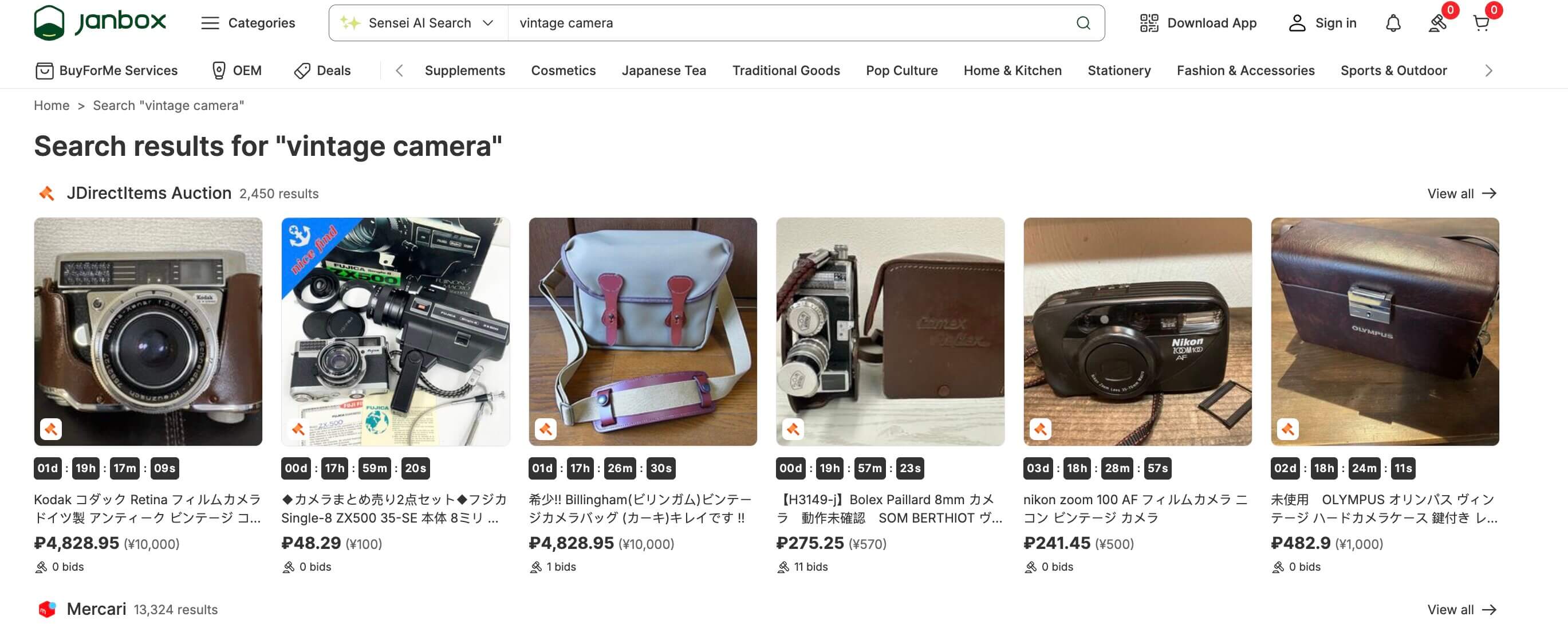
Not every purchase comes directly from a brand. Many shoppers buy products through marketplaces that host thousands of independent sellers.
For example, a collector in Germany purchasing a vintage camera from Yahoo Auctions Japan or a customer in the United Kingdom ordering stationery through Rakuten is participating in cross-border eCommerce. Although the marketplace connects buyers and sellers, the products are still shipped internationally from one country to another.
This model gives shoppers access to products that are often unavailable in their local markets.
Purchasing Country-Exclusive Products
Some products are designed exclusively for domestic markets and are never officially released overseas. Japanese cosmetics, regional KitKat flavors, anime merchandise, limited-edition sneakers, and collectible figures are common examples.
Because these products are sold only through domestic retailers or marketplaces, international customers often rely on proxy shopping or cross-border shopping services to complete the purchase. This is one of the fastest-growing areas of consumer cross-border eCommerce.
A Small Business Selling Worldwide
Cross-border eCommerce is not limited to large corporations. A small Shopify store can also sell internationally by enabling multiple currencies, international shipping, and overseas payment methods.
For example, an Australian business selling handmade candles may receive orders from customers in the United States, Canada, and Europe without opening physical stores in those countries. The internet allows even small businesses to serve a global customer base.
Manufacturers Supplying Overseas Businesses
Cross-border eCommerce also supports international supply chains. Instead of selling to individual consumers, manufacturers may sell products in bulk to overseas retailers or distributors.
For example, a Vietnamese furniture manufacturer exporting products to retail chains in Europe or a Japanese electronics supplier shipping components to companies in North America are both participating in B2B cross-border eCommerce. These transactions usually involve larger order quantities, negotiated pricing, and commercial shipping arrangements.
Benefits of Cross-Border eCommerce
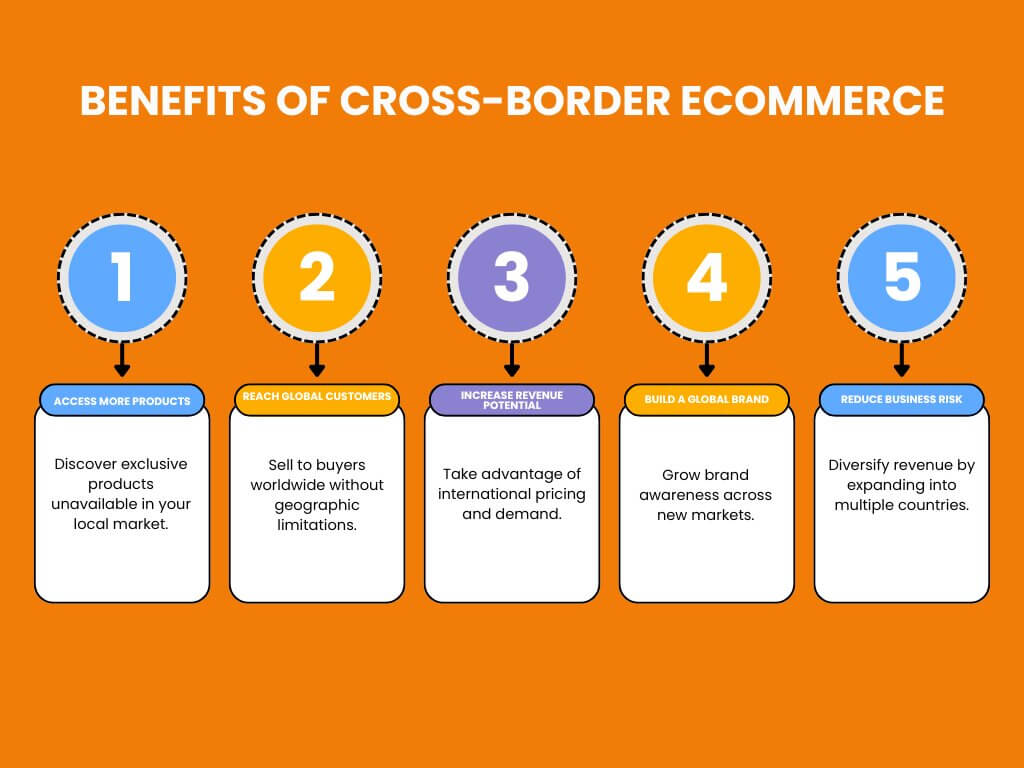
Cross-border eCommerce creates opportunities for both consumers and businesses. Buyers gain access to products that may not exist in their local markets, while sellers can expand beyond the limitations of domestic demand. As international logistics and digital commerce continue to improve, these advantages have become accessible to businesses of almost any size.
Access to More Products
One of the biggest advantages for consumers is product availability. Every country has brands, product lines, or limited-edition releases that are difficult or impossible to purchase elsewhere. Through cross-border eCommerce, shoppers are no longer restricted to local retailers. They can compare products from different countries, discover exclusive items, and choose from a much wider selection than their domestic market alone can offer.
For example, someone interested in Japanese skincare, regional snacks, or anime collectibles can order directly from Japan instead of relying on local import stores with limited inventory and higher markups.
Reach International Customers
For businesses, cross-border eCommerce removes many of the geographic barriers that traditionally limited growth. Instead of relying solely on customers within one country, companies can introduce their products to millions of potential buyers around the world.
This wider reach is particularly valuable for niche brands. A product with limited demand in one market may have a much larger audience overseas, allowing businesses to grow without opening physical stores or establishing local offices.
Better Pricing Opportunities
Selling internationally also creates greater pricing flexibility. Products that are considered common in one country may command premium prices in another because of limited availability, import costs, or stronger demand.
Businesses can use these market differences to improve profit margins, while consumers often compare international prices to find better deals. Even after shipping and import fees, purchasing directly from another country can sometimes be more affordable than buying through local resellers.
Brand Expansion
Entering international markets helps businesses build brand awareness beyond their home country. As more customers discover and purchase their products, brands can establish a global reputation without making the significant investment required for physical retail expansion.
Over time, international sales also provide valuable insights into customer preferences, helping businesses identify promising markets for future localization, partnerships, or regional distribution.
Diversified Revenue Sources
Depending on a single domestic market can make businesses more vulnerable to economic slowdowns, seasonal demand, or changing consumer behavior. Cross-border eCommerce spreads sales across multiple countries, reducing reliance on any one market.
If demand weakens in one region, sales from other countries may help offset the decline. This broader customer base can create more stable revenue over time while opening new opportunities for long-term growth.
Challenges Businesses Should Prepare For
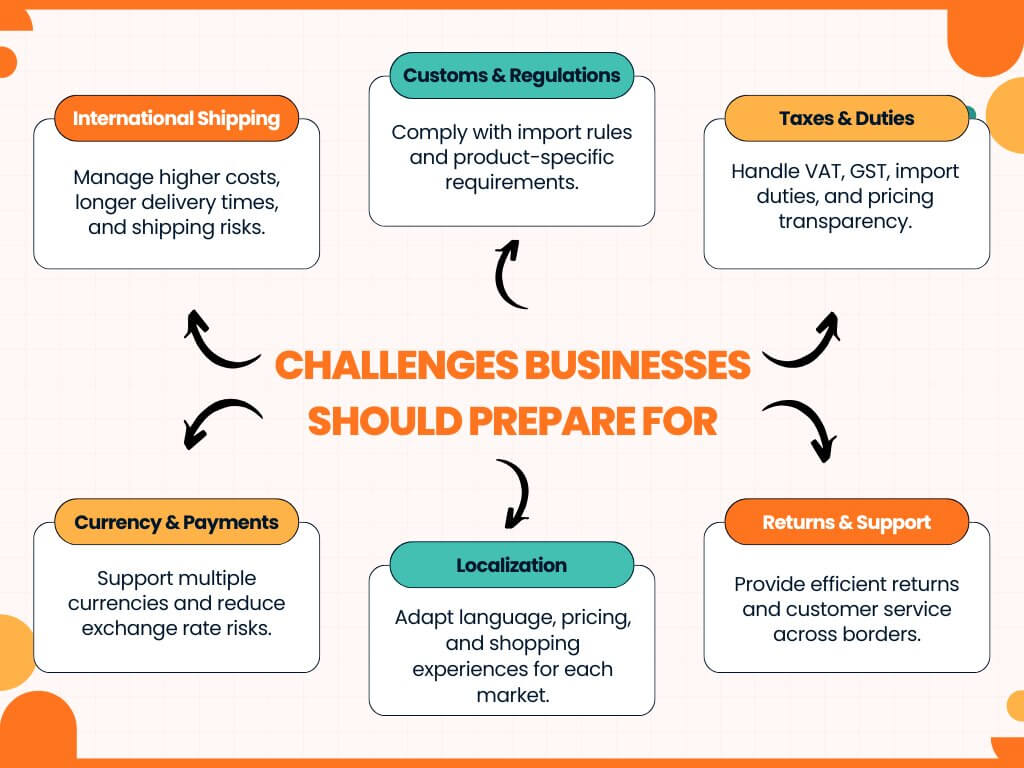
While cross-border eCommerce offers significant growth opportunities, selling internationally also introduces additional complexity. Unlike domestic commerce, businesses must coordinate logistics, comply with regulations in multiple countries, and deliver a shopping experience that meets local customer expectations. Understanding these challenges early makes it easier to build a scalable international operation.
International Shipping
Shipping products across borders is often slower, more expensive, and more complex than domestic delivery. Businesses need to choose reliable logistics partners, estimate shipping costs accurately, and provide realistic delivery timelines for customers in different countries.
As shipping distances increase, so do the risks of delays, damaged packages, or lost shipments. These issues can directly affect customer satisfaction and increase support costs if they are not managed properly.
Customs and Import Regulations
Every country has its own import requirements for products entering the market. Businesses may need to prepare customs declarations, commercial invoices, product classifications, or certificates depending on what they sell and where they ship.
Regulations also vary by product category. Items such as cosmetics, food, electronics, or medical products may require additional documentation or face import restrictions. Failing to meet these requirements can result in customs delays or rejected shipments.
Taxes and Duties
International orders may be subject to import duties, value-added tax (VAT), goods and services tax (GST), or other local taxes. One of the biggest challenges is determining who is responsible for paying these charges: the seller or the customer.
Unexpected fees at delivery often lead to abandoned purchases, refused packages, or customer complaints. To avoid confusion, many businesses clearly communicate estimated taxes and duties before customers complete their orders.
Currency Conversion
Selling internationally means accepting payments in different currencies while managing exchange rate fluctuations. If pricing is not updated regularly, currency movements can reduce profit margins or create inconsistent pricing across markets.
Businesses also need payment providers that support multiple currencies and preferred local payment methods to minimize friction during checkout.
Language and Localization
Expanding into new markets involves much more than translating a website. Customers expect product descriptions, sizing information, pricing, payment options, and even marketing messages to reflect their local language and shopping habits.
A localized shopping experience builds trust and helps customers make purchasing decisions with greater confidence, while poorly localized stores often experience lower conversion rates.
Returns and Customer Support
Handling returns becomes more challenging when products travel internationally. Businesses need clear return policies, practical return shipping options, and efficient communication throughout the process.
Customer support also needs to account for language differences, time zones, and varying expectations across markets. Responding quickly and resolving issues effectively can have a significant impact on customer satisfaction and repeat purchases.
How Janbox Simplifies Cross-Border Shopping from Japan
Navigating the Japanese domestic market from overseas presents severe operational friction for independent digital merchants. Most primary Japanese storefronts operating on platforms like Rakuten Ichiba utilize strict firewalls that systematically reject international credit cards, mandate native Japanese addresses for checkout, and refuse to communicate in languages other than Japanese. Janbox functions as a specialized cross-border infrastructure layer that completely eliminates these transactional and structural barriers.
The platform streamlines the international sourcing pipeline through a centralized system that handles procurement, quality control, and global shipping:
API-driven catalog integration: Janbox connects directly to major Japanese marketplaces via secure API integrations. This allows you to browse live product listings, view real-time inventory levels, and purchase authentic Japanese goods using standard global credit cards or digital payment gateways without facing localized payment rejections.
Forty-five days of free warehouse storage: Once purchased, domestic Japanese suppliers ship your items to a secure Janbox processing facility located in Tokyo. Janbox provides forty-five days of entirely free storage space, allowing you to hold inventory, gather multiple incoming shipments from distinct vendors, and pool your products before exporting.
Logistics optimization and shipping consolidation: Shipping small, individual retail boxes internationally destroys your profit margins due to high base carrier rates. The Janbox warehouse team manually executes a strict package optimization protocol, stripping away heavy outer domestic supplier cardboard, consolidating multiple orders into a single secure box, and reducing dimensional weight to cut international air express freight costs by up to eighty percent.
Automated blind-shipping protection: To protect your brand equity and prevent your customers from discovering original wholesale pricing, Janbox handles compliance and white-label packaging. The warehouse team removes all native Japanese retail invoices, merchant promotional flyers, and local price tags before dispatching the goods via global air couriers like DHL or FedEx with real-time tracking coordinates automatically fed back to your operation.
Conclusion
Cross-border eCommerce makes it possible for businesses to sell internationally and for consumers to shop beyond their local markets. As global logistics, digital payments, and online marketplaces continue to evolve, buying and selling across borders has become more accessible than ever.
If you're interested in purchasing products directly from Japan, Janbox simplifies the process by providing access to major Japanese marketplaces, proxy purchasing, package consolidation, and international shipping, making cross-border shopping easier from start to finish.
FAQs
What is an example of cross-border eCommerce?
A customer in the United States buying skincare from Japan or a business in Germany selling products to customers in Australia are both examples of cross-border eCommerce because the transaction takes place between different countries.
Is cross-border eCommerce only for large businesses?
No. Small businesses, startups, and even individual sellers can participate using their own online stores or international marketplaces. Modern payment and logistics services have made global selling much more accessible.
Do all products qualify for cross-border shipping?
Not always. Some products are restricted by import regulations or require additional documentation depending on the destination country. Requirements vary by product category and local laws.
What are the biggest challenges of cross-border eCommerce?
The most common challenges include international shipping, customs clearance, import taxes, currency conversion, localization, and handling returns across different countries.
How can I buy products from Japanese stores that don't ship internationally?
You can use a cross-border shopping platform like Janbox. It allows you to purchase from Japanese marketplaces, receive orders at a local warehouse in Japan, consolidate packages, and arrange international delivery to your country.
Table of Contents
Related Posts