How to Find Reliable Suppliers from Japan (Without Flying to Japan)
Finding reliable suppliers from Japan isn't always as straightforward as running a quick Google search. Many of the country's best manufacturers and wholesalers focus on the domestic market, while others have limited English information or don't actively market to overseas buyers. That often makes it difficult to know where to start, even when you already know what products you want to source.
The good news is that you don't need to travel to Japan to build a reliable supply network. From wholesale platforms and manufacturer directories to Japanese marketplaces and proxy buying services, there are several ways to connect with trusted suppliers from anywhere in the world.
This guide covers the different types of Japanese suppliers, the best platforms to find them, how to evaluate potential partners, and practical tips for sourcing products from Japan with confidence.
Why do businesses source products from Japan?
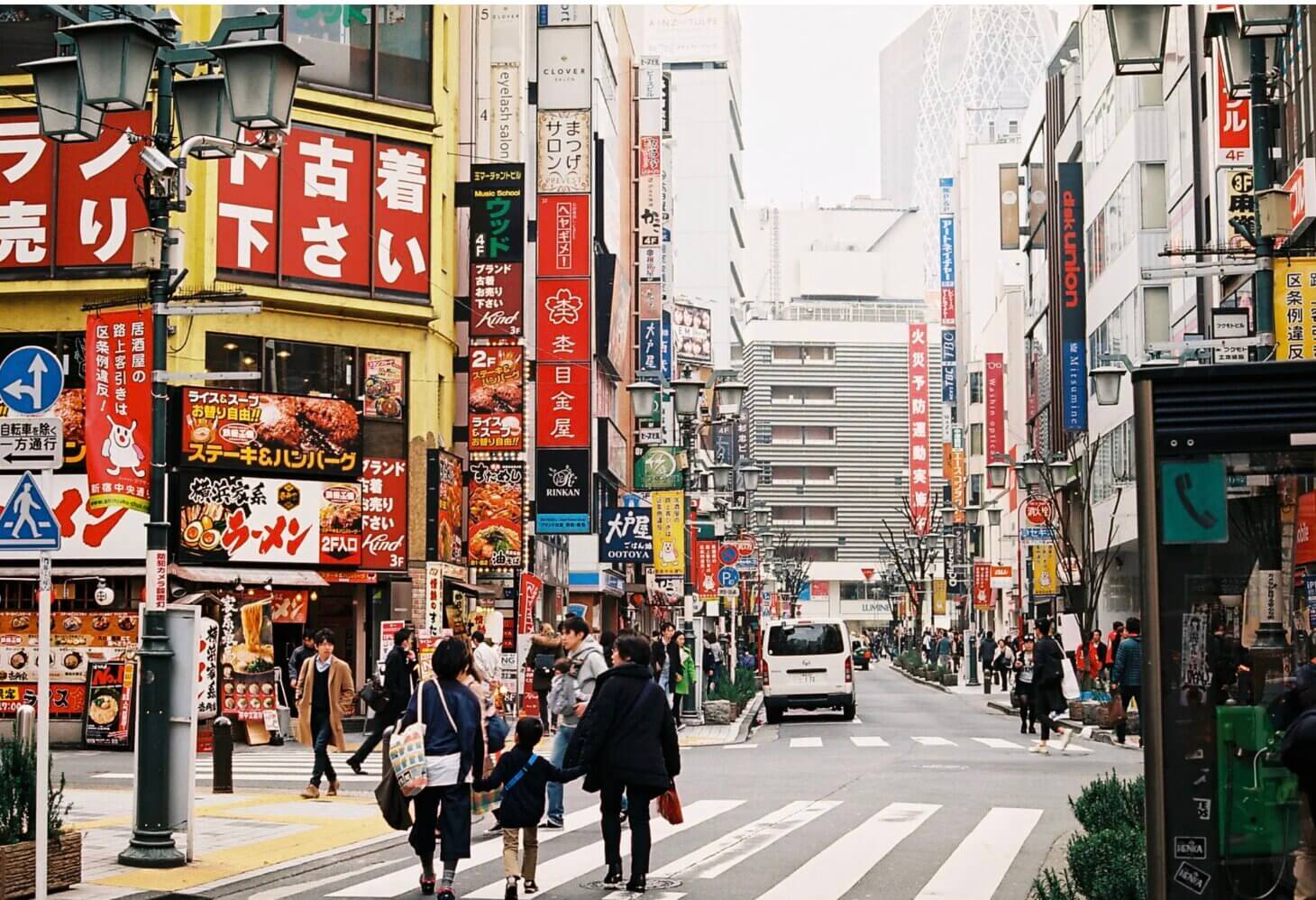
Japan has earned a reputation for producing goods that are reliable, well-made, and consistent. Many manufacturers follow strict production standards and quality control processes, which is one reason businesses around the world continue to source products from Japan.
Some of Japan's strongest export categories include:
Electronics and electronic components
Automotive parts
Cosmetics and skincare
Green tea and matcha
Kitchenware and tableware
Stationery and office supplies
Collectibles, toys, and hobby products
Across many of these industries, manufacturers place a strong focus on precision and product consistency. Quality checks are often carried out throughout the production process rather than only at the final stage. That gives buyers greater confidence that products will meet the same standard from one shipment to the next.
Japan also has a highly developed domestic distribution network. Products can move efficiently between factories, warehouses, and retailers, making it easier for suppliers to fulfill orders accurately and reduce shipping damage before products even leave the country.
Of course, finding the right supplier still takes research. Some companies only sell within Japan, while others require larger minimum orders or communicate mainly in Japanese. Understanding the different types of suppliers is the first step toward building a reliable sourcing strategy.
What Types of Japanese Suppliers Can You Work With?
When people talk about suppliers from Japan, they often picture manufacturers. In reality, there are several ways to source products, and each supplier type serves a different purpose. Some are better for large wholesale orders, while others work well if you're buying samples or testing new products.
Before choosing where to source, it's worth understanding how each option works. Below are the main types of Japanese suppliers you'll come across.
Manufacturers
If you're planning to place large orders or develop your own branded products, working directly with a manufacturer is often the best option.
Manufacturers produce goods in their own factories, so they have full control over production and quality. They may also offer OEM or ODM services if you want to customize a product.
The trade-off is that many manufacturers expect larger order quantities. Some also work mainly with domestic businesses, so communication in English or small trial orders may not always be available.
Learn more: Japan Wholesale Clothing Manufacturers Explained: What Buyers Should Know
Wholesalers
Not every business needs to buy directly from a factory. Many buyers prefer wholesalers because they can source products from multiple brands through a single supplier.
This makes wholesalers a practical choice for retailers, online sellers, or importers who want to build a product catalog without placing large orders with several manufacturers. They also make it easier to compare products, mix different categories, and order in smaller quantities.
Read more: The Ultimate List of Wholesale Suppliers in Japan for Global Buyers
Trading Companies
Finding suppliers is only part of the process. Communicating with them, negotiating prices, arranging inspections, and preparing export documents can take much more time than many buyers expect.
That's why some businesses choose to work with trading companies. They act as a bridge between overseas buyers and Japanese suppliers, handling much of the sourcing process on your behalf. While this usually adds a service fee, it can make sourcing much smoother, especially if you're buying from Japan for the first time.
Distributors
If you're looking for well-known Japanese brands, an authorized distributor may be the right place to start.
Distributors work directly with manufacturers and are responsible for supplying specific brands or product lines. They often provide a more stable supply, genuine products, and better after-sales support than unofficial resellers.
For businesses planning long-term partnerships with established brands, distributors can be a reliable sourcing channel.
Domestic Marketplace Sellers
Not every product needs to come from a manufacturer or wholesaler. In fact, many businesses start by buying from domestic marketplaces.
Some platforms like Rakuten Japan, Yahoo Shopping Japan, and Amazon Japan are home to thousands of official brand stores, specialty retailers, and independent sellers. They're useful for ordering samples, testing new products, or finding limited-edition and Japan-only items before committing to larger purchases.
This approach also gives buyers a chance to understand product quality and market demand before moving on to wholesale sourcing.
Effective Methods to Find and Source Suppliers from Japan
To build an efficient and resilient supply chain, your business should avoid relying on a single purchasing channel. The most successful global brands combine online databases with physical networking methods, scaling their procurement channels up or down depending on their operational budget, target niches, and business volume.
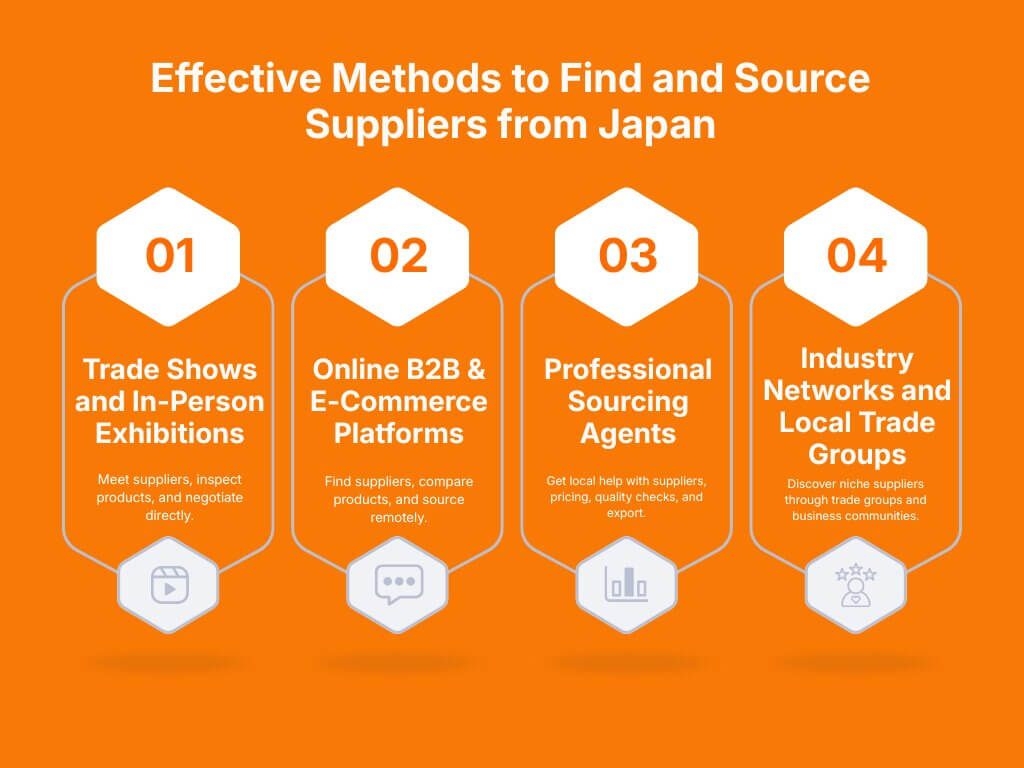
Trade Shows and In-Person Exhibitions
Traveling to Japan can be expensive, but it gives buyers something online sourcing cannot: direct access to products, suppliers, and business conversations in the same place.
At a trade show, you can touch product materials, compare samples, check packaging quality, and speak with company representatives before placing an order. This matters when you are buying for retail distribution, private label, or large-volume wholesale, where a wrong supplier choice can become costly.
In Japan, in-person meetings also help build trust. Many suppliers prefer to understand who they are working with before discussing larger orders, exclusive distribution, or long-term cooperation. A face-to-face conversation can make those discussions smoother than a cold email.
A strong example is Tokyo International Gift Show, one of Japan’s major trade fairs for lifestyle goods, consumer products, and gifts. It is held at Tokyo Big Sight and attracts thousands of exhibitors, making it a useful place to spot new product trends before they become widely available online.
This method works best for large enterprise buyers, retail chain distributors, brand owners, and businesses looking to negotiate exclusive international distribution rights.
Online B2B & E-Commerce Platforms
Utilizing digital procurement networks is the fastest, most cost-effective way to source products from Japan without leaving your office. These platforms range from modern, automated dropshipping marketplaces to classic business directories.
The table below provides a comparative analysis of the top online channels to help you choose the right digital path for your business model:
Platform Name | Integration Method | Core Product Focus | MOQ Requirement | International Shipping Speed | Best Suited For |
Automated API & Comprehensive Marketplace | Anime, J-Beauty, Secondhand Luxury, Local Domestic Brands | None (1 item allowed) | 3–7 Business Days (DHL, FedEx) / 3–6 Days (EMS) | Hands-free dropshipping of millions of listings pulled directly from top Japanese consumer networks. | |
Ichiba Oneplatform | All-in-One OMS Software & Sourcing Gateway | High-demand Retail Goods, Electronics, Private Label | None to Low (Flexible scaling) | 5–10 Business Days (Multi-warehouse fulfillment) | Multi-channel dropshippers requiring deep software integration, automated order syncing, and blind shipping. |
Super Delivery | Manual Dashboard (Locked Wholesale Portal) | Apparel, Traditional Housewares, Kitchenware | Very Low (Most vendors offer No MOQ) | 5–14 Business Days (Via Assigned Forwarder) | Established boutiques looking for authentic, direct-from-factory wholesale pricing. |
NETSEA | Manual CSV Export (Native Japanese Portal) | Trendy Fashion, Subculture Goods, Daily General Merchandise | Varies by individual domestic distributor | 7–14 Business Days (Requires third-party forwarder) | Experienced niche curators capable of handling native Japanese interfaces for raw trade prices. |
TopSeller | Automated CSV Sync & Order Management Log | Mass-market Consumer Goods, Electronics, General SKUs | None (Built for dropshipping drops) | 5–10 Business Days (Domestic focus; requires forwarder for export) | Structured e-commerce stores requiring deep catalog variations and automated inventory updates. |
Orosy | Modern Curated B2B Interface | Indie Creator Brands, Organic Cosmetics, Artisanal Lifestyle Items | None to Low (Flexible vendor terms) | 4–9 Business Days (Standard global express lines) | High-end Shopify stores focusing on unique premium aesthetics rather than mass commodities. |
CJdropshipping | Fully Automated Shopify/WooCommerce App | Sourced Consumer Goods, Trending Global Gadgets | None (Fully automated logistics) | 3–8 Business Days (Via Yamato, Sagawa, or private lines) | General dropshippers who want a hands-off, white-label automated fulfillment workflow. |
Janbox
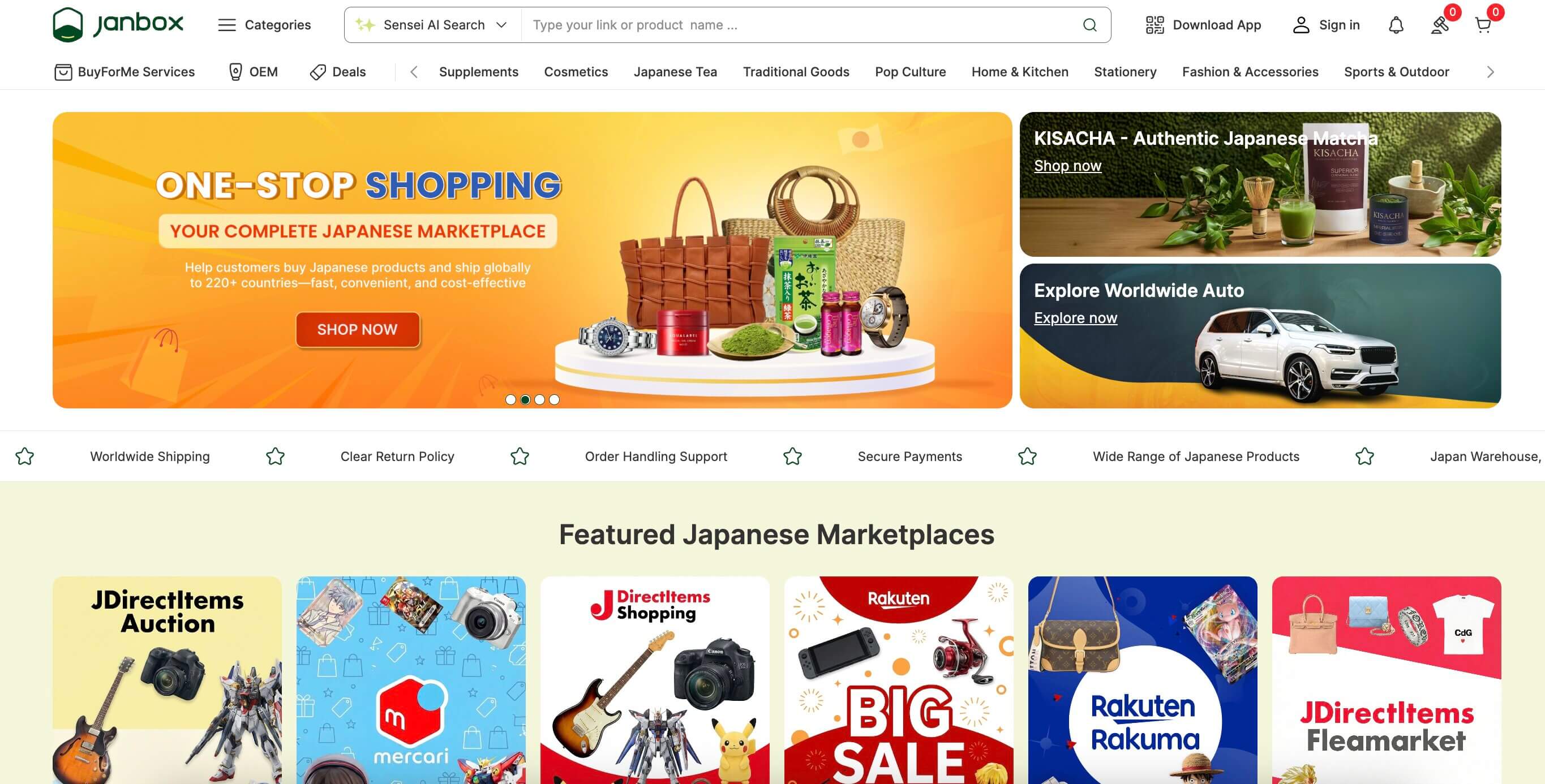
Janbox operates as a powerful cross-border procurement ecosystem and a comprehensive marketplace, serving as an agile dropshipping engine for global e-commerce merchants. Far from just a basic Japanese proxy-buying service, Janbox serves as a centralized marketplace hub by integrating its API infrastructure directly with Japan's largest domestic retail network, including Amazon Japan, Rakuten, Yahoo Shopping, Mercari, and Yahoo Auctions. This setup allows automated storefronts to instantly tap into millions of active, live listings right from a single, unified dashboard.
For dropshipping sellers, it eliminates foreign card restrictions and language barriers by allowing you to scan, search, and purchase products using your native language while the platform synchronizes with the original Japanese backend in real time.
The true operational value of Janbox lies in its highly optimized global logistics infrastructure:
Smart warehousing infrastructure: The platform provides users with a secure local warehouse address in Tokyo alongside 45 days of entirely free storage. This extended window allows dropshippers to comfortably gather and manage multiple small orders from independent sellers across various Japanese prefectures before exporting.
Package consolidation & Volume optimization: Once your inventory arrives, Janbox’s warehouse team performs professional quality control (QC) checks, removes bulky domestic retail boxes, and combines multiple parcels into a single, optimized shipment. This compact repackaging minimizes dimensional weight and slashes international express shipping rates by up to 80%.
Cross-border payment integration: Janbox removes the friction of foreign credit card rejections by local merchants through a secure, highly diversified multi-currency payment backend that processes transactions smoothly.
Ichiba Oneplatform
Ichiba Oneplatform is a next-generation, all-in-one dropshipping software ecosystem and marketplace designed explicitly for high-volume cross-border merchants and automated digital storefronts. Rather than forcing store owners to manually locate independent distributors or message individual factories, Ichiba establishes a direct digital trade pipeline. The platform connects users with a vast, pre-vetted catalog of over 1 million authentic Japanese products from trusted local suppliers and manufacturing facilities.
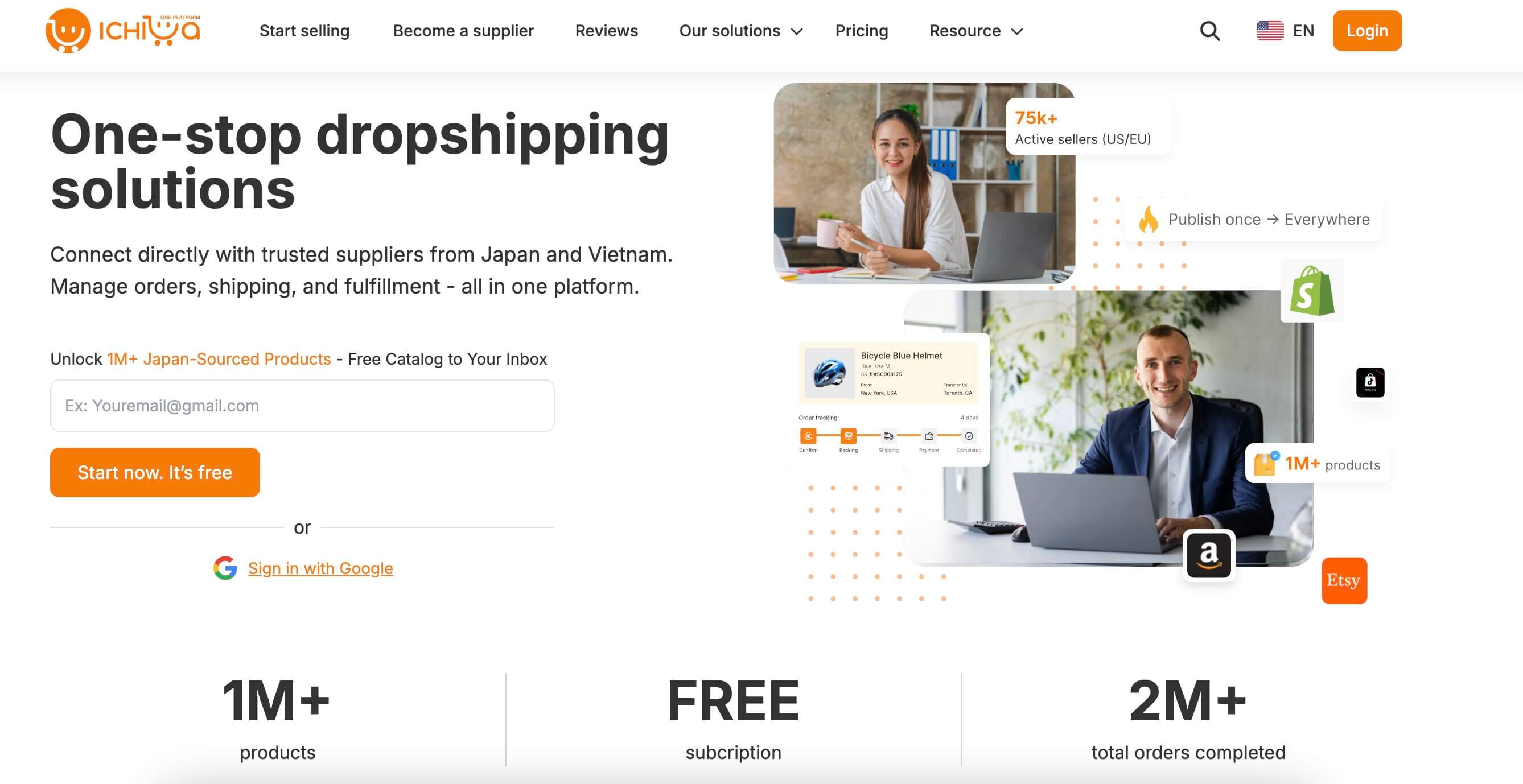
The distinct competitive advantage of Ichiba Oneplatform centers on its ability to completely automate the cross-border supply chain:
Omnichannel store synchronization: The underlying SaaS architecture integrates seamlessly with popular global e-commerce channels, allowing you to sync and push high-margin Japanese products directly to platforms like Shopify, Amazon, Etsy, and TikTok Shop.
Hands-free automated fulfillment: The moment an international customer places an order and checks out on your retail store, the system automatically routes the fulfillment data directly to Ichiba's backend. This instantly triggers automated procurement and routes the domestic cargo to one of Ichiba’s 6+ global fulfillment warehouses.
Blind-shipping & real-time tracking: At the central fulfillment hub, items undergo strict quality checks and are repackaged under a strict blind-shipping model, completely stripping away original domestic invoice paperwork or local supplier branding to protect your storefront's brand identity. The package is then dispatched via premium international air lines, and the system automatically updates your store with real-time end-to-end global tracking coordinates.
Super Delivery
Super Delivery connects international retail store owners and e-commerce sellers directly with more than 3,000 local Japanese manufacturers, apparel designers, and lifestyle brands. Because it bypasses traditional multi-layered export middlemen, the platform displays authentic wholesale pricing, allowing registered businesses to purchase premium inventory at substantial trade discounts ranging from 30% to 70% off standard retail values.
Accessing the catalog requires passing a business verification review, but it offers an incredibly stable supply chain across home decor, clothing, stationery, and beauty, with many listed vendors offering a "No MOQ" policy for agile inventory sourcing.
NETSEA
NETSEA is one of Japan's largest native B2B wholesale portals, handling high-volume inventory cycles for thousands of domestic retail storefronts inside Japan. It serves as an exceptional procurement ground for discovering trendy fashion items, beauty accessories, and seasonal lifestyle goods directly from Japanese distributors. Because the platform is designed primarily for the domestic market and operates entirely in Japanese, navigating its interface requires translation tools or a local forwarding service. However, it unlocks access to hyper-competitive local trade prices that remain completely invisible to standard global sourcing tools.
TopSeller & Orosy
These specialized supplier directories are built to optimize inventory workflows for digital e-commerce storefronts.
TopSeller provides deep CSV product logs containing hundreds of thousands of active consumer items and general SKUs ready for individual order dispatch, making it a highly reliable backend option for structured storefront layouts.
Orosy concentrates heavily on design-forward independent Japanese creators, boutique cosmetics brands, and artisanal lifestyle products. It offers a clean interface that simplifies communication with local indie suppliers, making it perfect for curated retail concepts.
J-GoodTech
J-GoodTech is an institutional business-matching directory owned and managed directly by SME Support Japan, an official government agency. Instead of processing standard online retail or dropshipping transactions, this platform catalogs over 25,000 elite Japanese small and medium enterprises specializing in machinery, electronics, advanced engineering, and custom manufacturing. Businesses use the platform to post detailed requirements, review verified company profiles, and start direct conversations for custom formulations, contract manufacturing, or long-term private-label OEM/ODM partnerships.
Professional Sourcing Agents
Not every sourcing project can be completed through an online platform. If you're developing a private-label product, customizing an existing design, or working with a manufacturer on long-term production, having someone on the ground in Japan can make the process much easier.
A professional sourcing agent acts as your local representative throughout the project. They communicate with suppliers in Japanese, request quotations, compare manufacturers, arrange factory visits, inspect product quality, and coordinate shipping documents before your order leaves Japan. For overseas buyers unfamiliar with Japanese business practices, this support can help avoid misunderstandings and speed up negotiations.
Working with a sourcing agent is most valuable when the order involves product customization, OEM manufacturing, private-label production, or large-volume purchasing where supplier verification is just as important as product pricing.
Industry Networks and Local Trade Groups
Not every reliable supplier has an online storefront or appears on a B2B marketplace. Many small manufacturers and family-owned businesses still rely on industry associations, regional business networks, and long-term commercial relationships to find new buyers.
Building connections through these channels can open doors to suppliers that are difficult to discover through a standard Google search. Organizations such as JETRO (Japan External Trade Organization) regularly introduce overseas businesses to Japanese exporters, while industry associations, LinkedIn communities, and professional sourcing groups provide opportunities to exchange supplier recommendations and market insights.
This approach requires more time than searching online, but it can be worthwhile for businesses looking for specialized manufacturers, regional suppliers, or long-term sourcing partners that are not actively marketing their products on public marketplaces.
How to Choose Reliable Suppliers from Japan
Finding a supplier is only the first step. Before placing an order or starting a long-term partnership, take time to evaluate whether the supplier fits your business needs. A few simple checks early on can help you avoid unnecessary costs and communication issues later.
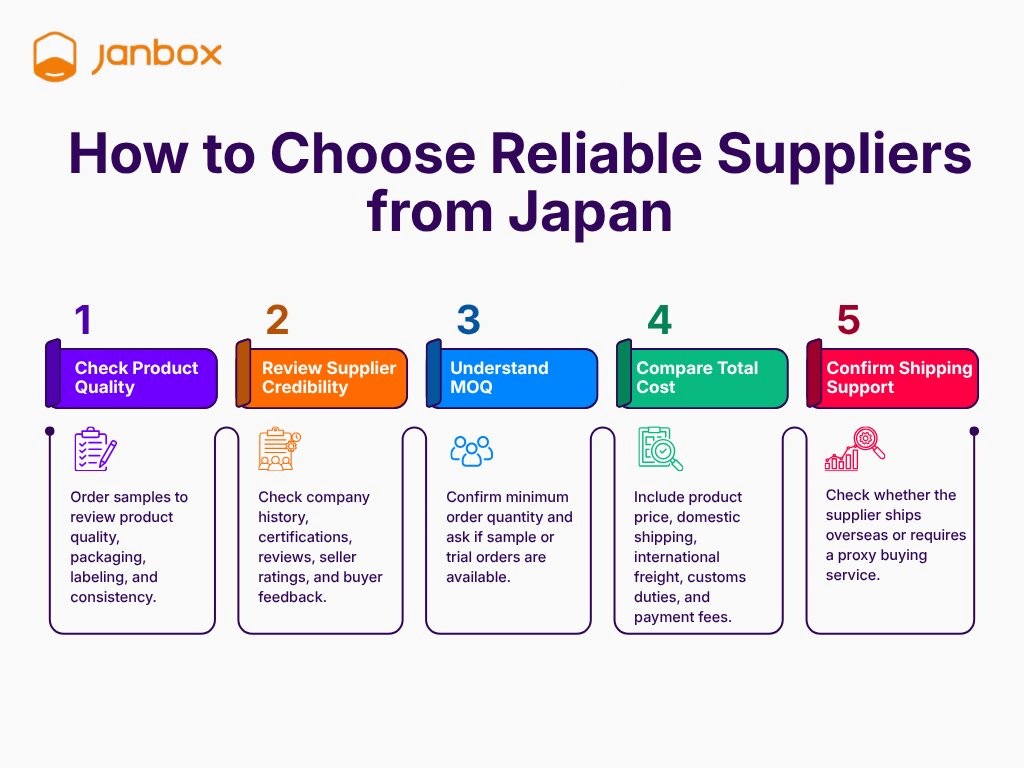
Check Product Quality and Consistency
Price often gets the most attention, but product quality is what keeps customers coming back.
Whenever possible, order samples before placing a larger order. This gives you a chance to evaluate the product itself, along with packaging quality, labeling, and overall presentation. If you plan to reorder in the future, ask whether the supplier can maintain the same specifications across different production batches.
Review Supplier Credibility
A professional-looking website doesn't always tell the full story.
Look for information such as how long the company has been in business, customer reviews, certifications, trade show participation, or partnerships with well-known brands. If you're sourcing through a marketplace, review seller ratings, completed orders, and buyer feedback before making a purchase.
>> See more: Top 10 Best Dropshipping Suppliers in Japan for Beginners
Understand MOQ and Order Flexibility
Minimum Order Quantity (MOQ) varies from one supplier to another. Manufacturers often require larger orders, while wholesalers and marketplace sellers may offer more flexibility.
Before contacting a supplier, confirm the minimum order requirement and ask whether sample orders or trial purchases are available. Starting small is often a practical way to evaluate both the product and the supplier before making a larger commitment.
Compare Total Cost Beyond Product Price
The lowest product price doesn't always mean the lowest sourcing cost.
When comparing suppliers, include other expenses such as domestic shipping within Japan, international freight, customs duties, payment fees, and packaging costs. Looking at the total landed cost gives you a much clearer picture of which supplier offers the best overall value.
Confirm Shipping and Export Support
Not every Japanese supplier is set up to work with overseas buyers.
Before placing an order, confirm whether the supplier exports directly, which countries they serve, and what shipping methods they support. If they only deliver within Japan, you'll need a proxy buying or forwarding service to complete the purchase and arrange international shipping.
Conclusion
Japan offers a wide range of sourcing opportunities, from manufacturers and wholesalers to domestic marketplaces and industry trade shows. The right option depends on what you're buying, how much you need, and whether you're looking for long-term supply or small product trials.
By understanding the different supplier types and choosing the right sourcing platform, international buyers can build more reliable supply chains while gaining access to products that are often unavailable outside Japan.
FAQs
How can I find reliable suppliers from Japan?
You can find Japanese suppliers through manufacturer directories, wholesale marketplaces, trade shows, and domestic platforms such as Rakuten Japan and Amazon Japan. Always verify the supplier's background and order samples before making large purchases.
Can I buy directly from Japanese manufacturers?
Yes, but many manufacturers have minimum order requirements and primarily work with business customers. Some also communicate mainly in Japanese or focus on the domestic market.
What is the best platform for sourcing products from Japan?
It depends on your sourcing goals. J-GoodTech is useful for finding manufacturers, Super Delivery focuses on wholesale products, while Janbox makes it easier for overseas buyers to access Japanese domestic marketplaces.
Do all Japanese suppliers ship internationally?
No. Many suppliers only ship within Japan. In those cases, you can use a proxy buying service like Janbox to purchase products and have them forwarded overseas.
Should I order samples before placing a wholesale order?
Yes. Ordering samples lets you check product quality, packaging, and supplier reliability before committing to a larger purchase, helping reduce sourcing risks.
Table of Contents
Related Posts